Wednesday, January 22, 2014

It's January 22nd Again

Another year has come and gone that marks the passing since Robert E. Howard stormed into the world in 1906. I raise a glass to your memory, friend-that-I-never-had. Your memory still burns brightly within us.

Tuesday, June 11, 2013

On An Anniversary

On this day in 1936 Robert E. Howard took his own life.

I have been trying for a long time to capture my love for him and his writing. I've mentioned it before on this blog. Though there are plenty of writers who work I feel very strongly about (Michael Ende, Neil Gaiman, William Gibson, Oscar Wilde, among many others), it's Howard who keeps coming up in my mind as the one I want to express my deep devotion to. Perhaps it's because, as a pulp writer, he's generally not as well respected as what we would call literary writers (a distinction that in itself is a product of the last hundred years). Perhaps it's because his most famous creation, Conan, has been thoroughly misrepresented in media, to the point that I fear the average person has lost the sense of who Conan really is. Like with so many other icons, the average person isn't getting the real creation, but rather a blurb version with none of his complexity or fire. To them, Conan has lost his brooding and philosophy, and has become an ape in a loincloth.

Part of it is also that I regularly recommend some of my favorite stuff to people, and I've never met someone I recommended Conan to who reacted to it anywhere nearly like how I did all those years ago when I picked up my first Conan pastiche. I repeatedly recommended "The People of the Black Circle" to a fellow student who showed interest in fantasy and even showed him where he could find it, but I don't think he ever read it. When I worked at a bookstore and I talked someone into buying a book of Conan stories, he returned it within a week.

I'm not out to try to prove that Robert Howard was a fantastic writer or that Conan is a brilliant work of art. I believe both of those things, but I also know (after spending too much time dragging myself through the tiers of academia) that REH's fantastic work doesn't need a defender such as I to recommend it; it speaks for itself, and I can neither add to it nor take away. If one day we fans manage to convince the literati that Howard has a vital place in the canon, I will be jubilant, but that's probably beyond my meager power. Now, I just want to be able to express what about his writing I find so compelling.

But every time I try, I feel ridiculous. When I admitted my devotion to Howard to a wonderful poet, he gave me a disappointed look and changed the subject. When I mention my hope to write criticism about his work to colleagues, they suggest I should try popular culture instead of literature. And yet I can't give up.

If we look at writers such as Jack London, Ernest Hemingway, and Rudyard Kipling, who have been accepted into the canon (though I could argue that, unfortunately, their stars have waned over the years), they write about many of the same themes as Howard does: exploration, survival in harsh environments, the triumph of humans over their environment, civilization versus the wild. They might have done so without murderous resurrected mummies, but the exploration of themes in Howard is every bit as rich.

And Howard talked about other themes. Love, mortality, personal fulfillment, science, loyalty, theology, sexism, tradition, and many more.

The writing is strong on a sentence level, too. The descriptions are vivid but economical, the language eloquent, the pacing fantastic. Howard's writing is a model for how to craft an intricate and gripping plot. His characters reveal surprising, even sublime, complexities and contradictions.

Talking about barbarism, conquest, and the bloody truths of steel and sinew is considered outmoded these days, as though civilization has moved beyond this "boyish" interests. We sit back on  leather sofas and watch news stories on our giant flat-screen TVs about the brutality that grips other countries and shake our heads at how far "behind" they are at becoming more like us, little realizing that our way of life isn't some end point on a cosmic sliding scale of national improvement. I know, given enough time, all civilizations will collapse back into this "outdated" norm. Barbarism isn't a fantasy but an inevitability. I can picture Roman citizens on their couches laughing about the backwardness of those unwashed simpletons on the frontier.

Maybe that's something Howard has to offer us. Every day, I feel like we're slipping closer to his descriptions of decadent, hedonistic, lazy societies too wrapped up in our petty interests and wars to notice our own slide towards downfall. If we look honestly, we have to admit we're there already.

Tuesday, June 12, 2012

Open Letter to the Gaming Industry: Real Swordfighting

 "You stab me and I'll stab you. Then you can stab me again. It'll be way more fun than actually swordfighting!"

Ladies and gentlemen,

Hit points are an outdated nonsense, a holdover Dungeons and Dragons-style games from the 70's, when hits were determined by rolling dice and consulting charts, and marking off numbers on a piece of paper was the only way to keep track of how much of the blood your character started her day with she still had sloshing around inside her arrow-riddled, sword-sliced body. It's a vague solution to measure injuries that makes up for earlier wargames having two modes for a character who just got hit by something: "dead" and "not dead." Hit points have nothing to do with combat, and they ruin any sense of immersion and realism. I refuse to believe that in an age when you can perfectly animate every hair in the flowing locks on the mane of the griffin I'm flying through a photo-realistic fantasy forest the size of Rhode Island, you can't do better than having a sword magically pass through someone's gut while a shower of blood covers up the two objects clipping through each other, while somewhere a health bar goes down a little bit. You can practically smell the Cheetos as a geek in someone's basement smudges the hit points on his character sheet and writes down a smaller number.

By 'health bars,' I don't just mean graphical representations of health, though that's part of the problem. I mean the assumption that the best way to hurt something is to hit it over and over again the same way, because after a certain number of the same hits, that something will magically fall over. A fight to the death is so much less exciting when the hero can take a sword through the face and keep on swinging. That kind of thing throws realism and immersion right out the window. It takes the dynamic, dramatic, wild excitement of a crazed melee and reduces it to politely trading stabs at the other person's torso, whittling down each other's lives like a synthetic Bloody Knuckles.

"Synthetic Bloody Knuckles" being the title for an awesome cyberpunk band.

There was a time games attempted to re-create a real-life experience in a virtual setting. Sports games still do that: they struggle to be as true-to-life as possible, even including things like weather, exhaustion, and injuries. Battle games, on the other hand, have moved into a world where fights have become more and more removed from reality. Instead of the smell of fresh turf plowed up by the hooves of heavy cavalry, the sound of jangling armor and shouts of fury and pain, the feel of  a leather-wrapped hilt sweaty under the warrior's palm, a game is filled with colorful flashes, swirls, and floating pictures. One weapon does ten times as many damage-points as another just because the game says so. A wound that would kill a newbie doesn't even affect a "high-level" player. None of this is meant to feel like actually going to war. The game doesn't represent anything any more. The game just represents the game.

"We shall see battle axes and swords, a-battering colored haumes and a-hacking through shields at entering melee; and many vassals smiting together, whence there run free the horses of the dead and wrecked. And when each man of prowess shall be come into the fray he thinks no more of (merely) breaking heads and arms, for a dead man is worth more than one taken alive." Or not.


I understand why some games, like modern shooters, have unrealistic amounts of health for the main character. You don't want to end up writhing in your own entrails when you get hit by the first dozen Nazis you come across. But that's a fundamentally different kind of experience from a real fight: you're simulating what it's like to be an unstoppable, virtually bulletproof juggernaut, a superhuman with Wolverine-like recuperative powers if he or she stays out of the crossfire for seven seconds. But that's not what I'm looking for from a swordfighting game.

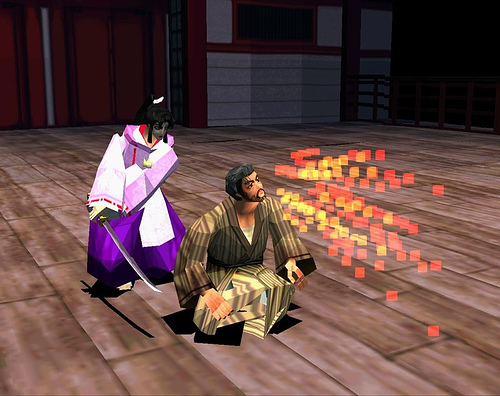
Many a long year ago, Bushido Blade on the PS1 gave us a fighting game which attempted to provide a more realistic swordfighting experience. A hit from a weapon could cripple a leg or an arm, and a single good body or head blow would mean death. You had to plan and time each exchange of attacks, and a miscalculation would mean your character's doom. It felt kind of like a real swordfight! Unfortunately, since this was 1997 and therefore the era in which characters looked like papercraft dolls, the simulation left something to be desired. Attacks were slow and ponderous, and you only had a very limited number of ways to swing each weapon.

We've come a long way.

I know I, for one, would give up having every one of my character's nose hairs individually reacting to her breathing just to be able to get something as simple as having her sword clang off my opponent's sword or armor. Every attack would matter as clashing swords would mean the difference between life and death, and my shield might be all that stands in the way of the evil dark lord's massive mace and my squishy internal organs. Imagine how much more interesting it would be if taking a dagger to the stomach caused my character to stumble around, slowly bleeding out, fighting on with the last of his strength, instead of shrugging it off and continuing as normal with a bit missing from his life score.

"I'll just go sit in the hall until my health regenerates."

After a fight, we could incorporate a system of wound treatment that might open up a whole new side of the gaming experience. If this causes a higher mortality among players, I'm okay with that. Maybe less-skilled players will be fairly easy to conquer for a talented player who knows the fighting system better, just like a skilled warrior can overcome a less experienced opponent--while still giving the underdog a fighting chance to score that lucky hit. Maybe it will force players to learn blocks, dodges, and counters to avoid those mortal blows, turning a fight into a series of strikes and blocks and ripostes just like a real fight. Who knows? The player might actually get better at the game by learning new skills, instead of the game arbitrarily giving him or her 'skill points' to represent the character growing stronger while the player just keeps doing the same old moves over and over.

But that's a letter for another day.

Your pal,
blue

PS You might say it's not in the "spirit of a game" for a character to spend weeks convalescing, or to have a shriveled arm or a missing eye from a grievous wound in battle. You might say that gets in the way of killing monsters and taking their loot. Maybe I'm just speaking for myself, but I'm not as interested in getting weapons with numbers attached to them or in 'leveling up.' I just want a good fight. And who knows? A character with a crippling injury might be cool....

PPS If you argue that the game is in a fantasy setting anyway, so life doesn't work the same way, I have two answers. First, can you name a fantasy novel in which a character gets run through a dozen times, shrugs it off, and keeps fighting without being the worse for it, without the novel explaining that this character is remarkable in some way? Second, in cut scenes in that same kind of game, getting stabbed or shot is suddenly treated realistically. No character gets his throat slit in a cut scene only to say, "It's fine! I still have half my life left!" Nobody walks up to you and says, "You look like you have lots of numbers in your points!" Even the game world doesn't acknowledge its own silly mechanics.


EDIT: http://www.kickstarter.com/projects/260688528/clang I would totally trust Neal Stephenson with making a badass swordfighting game. He's totally going to do a great... wait a second. What's that I see in the video? Hit point bars? BAH! Still, it's worth checking out.

Wednesday, May 16, 2012

Thank You, George Lucas

I remember loving Star Wars deeply as a child. I can't remember many things I was as enthusiastic about as Star Wars. I drew pictures about it endlessly, recreating scenes from memory days, weeks, or even longer after watching the film. My brothers and I played Star Wars all the time, making up our own stories using the characters from the films. Perhaps the biggest piece of praise I can give the films from my childhood is that Star Wars helped form me. Even today, when faced with something I don't know if I can overcome, I sometimes take comfort in the wisdom of Yoda's words: "Do, or do not. There is no try." or "You must unlearn what you have learned." or "So certain are you. Always with you what cannot be done."* or "Luminous beings are we, not this crude matter." I remember Han coming back for Luke even after he burned his bridges, or the way Obi-Wan sacrificed himself for the others.

One of the most formative times of my life was running around the house playing with Star Wars action figures. My brothers and I made huge plots that deviated wildly from the films, stories in which Obi-Wan survives and the heroes go on all sorts of magnificent adventures, stories which prominently featured Boba Fett and Darth Vader as the main villains. There was a time I watched Star Wars every week. My mother read us the Thrawn Trilogy as bedtime stories.

But that was "Before the dark times. Before the Empire."

Though it wasn't Empire that changed things for me, of course, it was The Phantom Menace. I remember standing in line for hours the day it came out. I didn't see the first showing, but even then the crowd was as excited and eager as I have ever seen an audience. Something changed in the fifteen-year-old me through that film, something which I don't have to get into in detail. I think I lost sight of something that I should have remembered.

That something is all those hours running around with an action figure clutched in each hand, shaking one or the other and making 'pew pew' noises, or making them whack each other with plastic lightsabers, going 'ksh ksh ksh.' It's all the pictures I drew of stormtroopers and laser sword fights and spaceships. Star Wars gave me a huge part of my childhood and some of my happiest memories.

And I owe all of this to George Lucas.

George Lucas has taken a lot of fire, especially from some of Star Wars's biggest fans, for what he has done, first in the special editions of the original trilogy (Han shot first!), and then in the new trilogy. But artists won't always create things I'm happy with. Even my favorite novelists wrote novels I don't like. I have let my own disappointment in the new Star Wars disguise what was most important: my happy childhood memories. And who knows? Maybe in twenty years, some other kid will be writing about how much he loved playing Anakin and Jar Jar.

George Lucas has consistently rejected fans' demands to "restore" Star Wars to the way they want it, and fans have been vocal about how they feel about it. But the truth is, George Lucas didn't ruin my childhood. He made it better.

Sometimes I think about why the live-action Star Wars TV show never materialized, and I wondered today whether that's because of how ungrateful we, as fans, have been. So let me go on record here saying, "Thank you, George Lucas. Thank you for giving me something I truly love."


* I've never been sure about the quote "Always with you what cannot be done." That middle word is hard to make out in the film. I have always heard "what." According to the Star Wars scripts I've looked at online, the word is "it." Hm. It may be time to unlearn what I have learned.

Friday, May 11, 2012

Writing Thought

Sometimes I think people with good, solid life skills (reliable, fundamentally solid and capable people) can't be writers, because they just solve all of their problems. Writers need to fail, agonize, suffer, freak out, avoid, and tear hair (theirs and others'). That's what makes for good stories, and you have to write what you know. If you keep it together and overcome your obstacles by working hard, where's the story in that?

Tuesday, May 8, 2012

More Thoughts on the PCA/ACA Conference

Now that I've told the story of my PCA/ACA Adventures, let me say a few thoughts in general about conferencing. I must admit, to start, that the $300 my university gives me to travel to conferences didn't even cover the $500+ for my plane ticket, let alone the $240 for a shared hotel room, the $50 shuttle ride, the $10+ on public transportation, and the $100+ on meals, including fries and chips so hard they left the insides of my mouth feeling like I had brushed my teeth with a dagger. One the other hand, that three hundred bucks did soften the blow a bit, and I'd gladly pay the rest to go hang out with some erudite Howardians. Part of the reason I go is also because some curious people might come over and be introduced to Howard who wouldn't otherwise pick up his work. At one of the panels, a young lady said she came because she was writing a paper about Black Mask magazine and wanted to know how people talk about the pulps, and a young gentleman said he came purely randomly. If those two leave and tell their friends how interesting that Robert E. Howard character seems, it's a job well done.

More than the actual price of being in Boston, it's the fees associated with going to the conference that bother me. We have to pay registration fees, fees to be members of the organization, and we also have to buy the journal they put out. I truly appreciate the opportunity the PCA/ACA gives us to come together and share our interests and scholarship, and I genuinely believe that a large conference like this is necessary, since it allows us to cross-pollinate and raise interest, as I mentioned above. And yet I wish it didn't come with such a prohibitive price tag.

When it comes down to it, I suspect this might be because "popular culture studies" just don't have the kind of academic heft that, say, Victorian studies or Shakespearean studies do. Maybe popular culture studies doesn't get the kind of funding support other areas do. I feel the struggle for legitimacy that we experience is a little hypocritical and short-sighted. After all, how many other disciplines have gone from "popular" to academic? In the 1800s, reading novels was considered low-brow and was even accused of corrupting peoples' morals. In Shakespeare's time, people looked down their noses at the theater, and they were considered so revolting that they stuck them on the other side of the Thames in London (I guess that was the Elizabethan equivalent of the train tracks). And yet now proper academics with patches on their tweed jackets and everything spend their time researching this stuff. Especially now, when there's such a big movement to discover and rediscover voices of minorities who have until now been ignored in the literary canon, I think that "popular" writers such as the weird fiction writers should be embraced and given the due they have so long been denied. The literary world is full of people who talk about the importance of literature and authors' voices; how can we draw a line and say whose voice is meaningful and whose isn't? We are in an age when ignored writers, those who wrote experimentally or went against the grain or were women or minorities, are being rediscovered and lauded. How can we say the contributions of writers once labeled unacceptable were unfairly dismissed and need to be honored, and then turn around and say, "But not those other writers over there!"?

Weird fiction came from a time of change, when the rise of steam, internal combustion, and electricity had all but destroyed the frontier, when social and class awareness rose in the face of the brutal factory system, when science and philosophy were rearranging the place of humans in the cosmos, and when the Great Depression made life brutal and bitter for millions. All of these are reflected in the stories of weird fiction writers. The kind of scholarship I believe will raise these writers in the esteem of academia will focus on examining their use of genuine literary talent to explore the themes of their age, not to mention more general literary analysis of their artistry, examining their work not just in terms of broad themes but looking deeper by using critical theory to analyze their work. I have been delighted to see this taking place at the PCA/ACA conference, with critical readings including gender, imagery, and the use of certain literary devices.

As I prepare for my comprehensive exams, I intend to look at the way weird fiction writers spoke to the class and economic situations of their time. I don't want to just say "they were shaped by the Great Depression" or look at the way they interacted with a mostly lower class literary form, but I rather want to look at ways they responded to this, even subverted types and played on reader expectations. For a group of men and women writing for a magazine that routinely had half-naked women writhing on the cover, they were a remarkably well-read and scholarly bunch, and their interest in history, literature, and science was amazing. They all defy what you might expect "pulp" writers to be like, but that's part of what makes them interesting. As they wrote in a "weird" genre which routinely pushed boundaries, they had the perfect form in which to explore ideas and themes that were taboo to discuss otherwise, and that allowed them to speak vitally and vibrantly to their generation and to literature as a whole.

Wednesday, May 2, 2012

PCA/ACA - Conference Adventures!

On April 11, I packed my knapsack, put on my traveling cloak, kissed my mother, and set off from the homestead to find fortune in the greater world. After a trip in a van, two airplanes, a bus that went underground, and another train, I found myself in front of the Boston Marriott at Copley Plaza. In the spacious lobby, I saw a motley assortment of my colleagues, who had arrived for the annual PCA/ACA National Conference. By this point I was so addled by having gone up and down so many times, not to mention the sheer Transformers-like boggle of having been in a bus that hooked up to electric cables and went drove through an underground tunnel pretending it was the metro, I managed to stammer my way through getting my room key. After riding up to the twenty-sixth floor, I deposited my stuff in a room I was sharing with my friend and went in search of adventure.

My first experience was inauspicious: at registration, I put my name card in my pocket, couldn't find it in my bag, and went back to ask for it. Only when the no doubt overworked but extremely patient and polite gentleman told me to look in my pocket did I realize my mistake. Feeling a sheepishness not even my all-black outfit could fully overcome (no doubt due to the fact that I was still wearing white sneakers; I was going to be doing a lot of walking!) I wandered around the conference, checking out the book tables and marking the panels I wanted to go to the next day.

That afternoon, I ran into an old friend from my undergraduate/MA years, who now lives near Boston and showed me and my friend from my current university around. We met up by the huge old library that had murals on the walls and a fine collection of nineteenth century manuscripts, including original letters from Poe and Hawthorne, and set off for Chinatown. We received some second-hand martial arts wisdom and bought some squid jerky, and we also went into a small cafe to buy some bubble tea. We waited perhaps ten minutes in front of the display case while every other customer to walk into the store after us went right up to the counter, pushing aside whoever was already there to place an order. When we finally did order, the nice girl recommended that I try the tea I ordered hot, and then asked me to make sure it was sweet enough after she prepared it for me. It was a surprising bit of kindness after the mild frustration of waiting.

We took our obligatory photos by the big touristy gates, then had dinner at a restaurant that used to be a theater. The walls were beautifully painted with scenic illustrations, and the walls had decorations of carved dragons and other mythical beasts. Although the room was huge, there were only a few families there, and we didn't get to experience having dim sum brought to us on carts. Instead, we ordered from menus, and ended up gorging ourselves on the various still-steaming balls of meat-stuffed dough. When we were done, we told our waiter we wanted our check split three ways, which caused a bit of tension and meant we shuffled out of there as fast as we could, considering the size of the meal we had just eaten.

The day done, I turned in early, and I got up early on Thursday to start attending panels properly. I was surprised to see two of my Howardian cohorts at a panel about science fiction and fantasy, so we touched base and went out to lunch. (I ended up eating perhaps the most expensive burger I have ever eaten, a blow which was only slightly softened by it being stacked so high I had to eat it with a knife and fork.) I couldn't get over how fantastic it is to talk to people who knew much more about one of my favorite topics than I do. Hearing some of the experts in the field of Howard studies discourse about his writings is the reason I went back to the PCA after last year. Sometimes I think I know a thing or two, but the level of understanding and background knowledge these guys has always leaves me listening wide-eyed and trying to remember as much as I can. At one point, I mentioned that the Howardian mountain man Breckenridge Elkins is bearded, but at a later panel every picture showed him clean-shaven. I guess I just assumed, given how often he's compared to a grizzly bear. My paradigm got thoroughly shifted.

I ended up on the last of three panels in the Pulp Studies field. I felt every panel was very interesting, though I admit I had a bit of trouble keeping my eyes open for some of it. (You can see me coming close to nodding off in the second row in a picture on Mark Finn's blog on the same topic.) This was no reflection on the quality of the presentations. One of my comrades-in-arms wrote about C.L. Moore, Margaret Brundage, and the portrayal of female adventurer Jirel of Joiry in Weird Tales (I particularly remember the part that in one scene in Moore's story Jirel changes out of armor into a fresh suit of armor; for her, there is no 'change' between selves--the identity in armor is her real identity). There was also a bit of debate about whether the horrors in At the Mountains of Madness represented immigrants, blacks, or a giant poo monster. There was an interesting connection made between the Necronomicon and censorship (forbidden knowledge!). One of my favorite readings was Mark Finn's presentation about gorillas in Howard's writings. I've often remarked about the frequency with which Howardian heroes come to grips with giant apes, and Mark made some great connections with race, barbarism, and evolution.

If anybody asks why I didn't go to George Takei's talk, I was learning about Robert E. Howard and killer gorillas, which is probably the best excuse I can think of for missing something like that.

As for my own panel, it's frankly a bit of a blur for me. I can't say much about it other than I was terrified, nervous, and I realized that my paper barely made sense to me as the writer, and anyone who was listening was bound to be even deeper in the dark. Everyone was nice about it, though, and I made a thorough mental note to write something more reasonable and straightforward next time and leave connecting Howardian heroes to political philosophy for people who understand that stuff a lot better than I do!

After I collapsed gasping and panting on the other end of my ordeal, we went out for dinner and drinks. This was my favorite part of the conference and worth the price of admission. The topic ranged from Weird Tales, movies, video games, collecting, comics, roleplaying games, and all sorts of other stuff. We ran into a young gentleman we talked to the last year who was in game studies, and we set up a time we would all get together to chuck some dice and talk about elves on Friday night.

My panel completed, or at least over, Friday was a lot easier for me. I attended my UNL friend's presentation, which was stuck early in the morning in a suite up on the thirty-somethingth floor, so the attendance was sadly thin. One day's other highlight panels for me were the Western panel on which one of my Howardian colleagues read about Breckenridge Elkins and rough-and-tumble fighting, which I never knew was a particular fighting style with its own techniques and rituals. The next highlight was the gaming panel about mapping. I had never put that much careful thought into the science of mapping out a roleplaying world, whether as the DM or as a player. While it's certainly true that Conan never carries around a compass and sketches out everywhere he's been, creating a map of the world one visits is an interesting 'living document' mixing elements of cartography with storytelling.

The Friday night Dungeons and Dragons game (I'll admit, it wasn't technically D&D, since we were playing the rules set developed by one of the gentlemen there, called Adventurer Conqueror King (and let me take another parenthetical to say how perfectly that title for the game matches up with playing with a bunch of Howardians)). We played for a while in one of the conference rooms, but then we moved out into one of the lobbies because the night crew had to come in to clean. We were there so late they even shut down the escalators. The adventure was a great deal of fun, though we didn't get to see nearly all of the dungeon or accomplish any of our goals. It captured the missing element of many of the games I had been in before: that sense of going into the unknown with a bunch of untrustworthy cutthroats (including a Family of vermin killers, an elderly priestess of a shall we say reproductive deity, a trio of mad priests worshiping a god of decay, and more kill-crazed dwarves than it is entirely safe to be around). Without modern hand-holding such as balanced encounters and linear paths, we experienced the true paranoia of exploring a mysterious dungeon where everything was trying to kill us, an experience made all the more terrifying by our precariously low hit points and the horrifying results of being incapacitated (having to roll on a chart to see our crippling injury). We spent most of our time not fighting or exploring but debating about which course of action was least likely to lead to our awful demise. Amidst a table crammed with snacks, we played in our imaginations, making only crude diagrams to show our marching order and not relying on figures to mark our places on a board. This made the game much more colorful for me, since it all happened in my mind, which has an even better budget for special effects than a well-stocked game board. Overall, this is exactly the kind of roleplaying experience I most enjoy.

After staying up to around two in the morning (after everyone announcing around ten how beat we all were), I staggered into bed and returned the next day to my university, staggering in a semi-conscious state through the airports. When I got back, my head was still buzzing and a list of things to research. If I find my camera, I'll add pictures to this blog. For the moment, it's lost in Movingspace, the place things go when you move and can't find them while unpacking.

Wednesday, April 4, 2012

"The Last Incantation"

I haven't written for a while, so I thought I'd say something, even though I don't feel I have much to say. I've found, while writing a blog, that it's sometimes difficult to try to reconcile three things I think are essential to a good blog post: a topic I find interesting, a topic my audience might find interesting, and a topic I can write at significant length about

At any rate, moving on from navel-gazing to the meat of the thing, I've been doing a lot of reading in the old Weird Tales-esque sword and sorcery genre. In moving beyond Robert E. Howard and H. P. Lovecraft in the genre, I have been reading Clark Ashton Smith. I find Smith's writing in general weaker than either of the two masters I mentioned. His characters are flat caricatures, his prose is excessively stilted and at times purple, and in general his stories feel more like sketchy anecdotes of strange misadventures than they do full stories. That being said, I've found one story I felt moved by: "The Last Incantation."


For your perusing pleasure

It's not long. You can read it in a few minutes.

There's some pretty classic evil sorcerer stuff going on here: the long-bearded ancient magician, the viper familiar living in a unicorn's skull, the ancient and unholy knowledge that no man should possess. But, at its root, the story is about love, melancholy, and remembrance. Even all the power of the universe cannot make Malygris happy, nor recall the happiness he had as a young man who had neither the knowledge nor the magic he possesses in his old age. He doubts even before he begins that the spell will bring him what he wants, and yet he must attempt it.

The emotion is subdued in the end. The magician is neither heartbroken nor furious; I get the feeling he is too old and withered to feel much even from this final disappointment--he has nothing left to him but his weariness and anguish. There is no single dusty tear; the only sign that he is moved is that his voice has become "thin and quavering." This withheld emotion is what makes the story work for me. Nylissa does not recoil from what he has become; she responds empty of emotion, leaving the scene's resonance squarely on Malygris.

Malygris, living alone except for his familiar, has long since seen all that is to be seen and conquered all that he had to conquer. He has sucked the juices out of life, and only the husk remains. He lives in dust and shadows. Even in this last scene, in which he performs an impossible and beautiful miracle, he is only an old man who has outlived his passions, waiting to die alone.

I do think the story is at times over-written, despite the restraint I praise. Smith, as he does in many of his stories, tells the reader what the reader already knows. For instance: "He could believe no longer in love or youth or beauty."


Or later, when Malygris refers to the "Nylissa whom I knew, or thought I knew?", the "or thought I knew" again hits us over the head with the theme.

And, if we still missed it, we get the familiar's Aesop-like endingline: "This, my master, was the thing that you had to learn."


Also, this would make for a wonderful low-budget short film.

Saturday, January 28, 2012

A Memory and a Dream

When I was a boy, I caught a snippet of a TV show in which I saw a child speaking with a life-sized animatronic monster in someone's workshop, the monster having come to actual life in her dream. I remember the child going into the vast room and seeing the creature, at first hanging limp, come to life and speak intelligently. It was the kind of creature effect they used to use in films and TV before they had CGI: limbs moved by pistons and a face of plastic and steel covered in rubber.

I was leaving the house at the time, so I only saw a few minutes of this show, but it stayed with me. This grabbed my attention so much that I dreamed with it many times, repeating the scene so often in my mind's eye that I felt almost as though I knew the whole story. It is one of my memories--if I can call something so distorted a memory at all.

The image of the child speaking with the half-made animatronic monster, only partially skinned and yet fully alive, entered into my own dreams. There was something about this thing, at first built to have the appearance of life, and yet taking on true life and intelligence, that moved me deeply. With the usual power of dreams, the image of this TV show segment became both distorted and sharper. One of the tricks of dreams is that they return our memories not as they were but as we felt them. The most remarkable features become amplified, with additions that our fancies use to build the vision even more. I can still clearly visualize the scene as I saw it: in my story, the story that I dreamed, the character speaking with the monster is a little girl, and her older brother is building this creature in the basement for a movie. The creature comes alive and speaks only to her, when she is asleep. In my dreams, the monster is a mix of the Gmork from The Neverending Story, which had a profound influence on me as a boy, and a dragon. The girl is curious and a little afraid, the monster is terrifying and clever, and yet doesn't mean her actual harm. He is malevolent, but not to her. He wants to be completed. She was afraid that if her brother completed the monster, the creature would kill her brother.

This scene came back to me through the years, and I think it stayed with me because it became such a potent symbol of the imagination itself. The imagination, like the maker of an animatronic monster, creates something in the image of life which isn't quite real, but seems as though it is. And yet that false memory feels just as real as things that really happened. That image, like the monster in my dream, takes on a life of its own, the representation becoming a unique living thing in its own right. To me, the story was about wonder, a little girl who doesn't quite understand what forces make an animatronic "live", and yet in whose imagination sees beyond the machine to the true essence of the monster. To her brother, it only is made to seem real. But to the girl, even half-built (and obviously not alive), it is real.

I had tried to find the show through internet searches, but couldn't locate it. I didn't know what keywords to use. Was the main character even a girl? A boy? How could I express an animatronic monster coming to life in terms Google would understand? And yet I didn't try very hard. I wasn't sure I wanted to find the original source. I preferred my own story.

All of this would have remained a vague memory that came to me once every so often, but about a week ago Netflix recommended something new on streaming: "Monster Maker," an episode of The Jim Henson Hour which aired in the late 80s and early 90s. And there it all was: the half-made creature that seems to come to life, the child, the conversation no one else seems to see. But in this version there is no brother and sister, just a boy. The things they talk about are completely different from what I remember. The story is about an imaginative British boy wanting to work for a legendary creature effects designer who lives in his neighborhood. The plot is fairly mundane; the show says some wonderful things about the power of the imagination, yet its main arc hardly involves the creature at all.

As I watched the episode, I was struck by these differences. I was sure, despite having seen this program more than twenty years ago, that the things I remembered were part of a real show. As it turned out, I was only partially right. I had to face that the show I remembered, about the little girl and her brother, never existed. I had been wrong. I had misremembered. This was the real show.

Or was it? When asked about memories years later, people vividly tell stories of things that never happened. To them, they did happen. And if there is no proof otherwise, who's to say what really happened? Maybe other children, like me, came up with their own versions of that show, versions that became a thousand different, unique stories about children and animatronic monsters. If I had never found this program, the story I made up would have remained real to me. And part of me hopes, even now that I've been 'set straight,' that I'll still dream about my version. After all, it did exist, in a way.

In my dreams.

Sunday, October 23, 2011

Because I Try to be Balanced


I found this on Facebook. Now, of all the things they could have highlighted in a game about Conan, things like an awesome fantasy setting, exotic locations, high adventure, weird magic, the chance to be a hero; they had to go with violence and people wanting to ban it? I love Conan and the Hyborian Age and everything sword-and-sorcery, and I love video games, and yet this ad still fails to get me the least bit excited for playing this game. Do they really think people are going to devote hours of their lives to something every week just because it's violent? Sometimes I swear the people who write the ads for Facebook are 14. Or they're probably not 14, they probably unhip old dudes trying to fumble blindly at that demographic based on focus groups they didn't understand and what they occasionally overhear their own kids saying. Conan is so much more than just violence, and it's definitely better than just trying to attract attention by being controversial. Come on. That puts it on the same level as GWAR. You don't want to go there. It's about adventure and mystery and heroism and wonder, not about getting your mom angry when she catches you playing it.

I have a better idea for an ad. It goes, "Know, o Prince, that between the years when the oceans drank Atlantis and the gleaming cities, and the rise of the sons of Aryas, there was an Age undreamed of, when shining kingdoms lay spread upon the world like blue mantles beneath the stars...."

Now that's something sure to get me hooked.

Don't even get me started why they're using some chick with cleavage instead of Conan himself. Reminds me of that ad with the half-naked woman for some game that was always popping up everywhere a few months ago. Just who is their target audience, considering the game is rated 18+? (That's a rhetorical question.)

Saturday, October 22, 2011

Just a Little Friendly Ribbing

So I saw this ad at the bottom of a story by Cracked.com and I got a chuckle out of it, partially because it was on a story about people being obnoxious. The cheerful, clean-cut, good-looking young people embracing, the logo cut off by its own picture, and the general optimism of a dating site gave me a good giggle. Plus there's that motto, "Find God's Match for You", which they're proud enough of to trademark. As though God has a match for me, and this site is the way an all-powerful divine being is going to make that match known to me.


But then I had a weird idea. Dating sites usually (not that I'd know) have a drop-down menu that allows me to search for various combinations of sexes. For instance, there's usually the option of male/female searching for male/female/both. Some of the sites even have transgendered or "other" options. So I got curious: what would the sexuality options be like on this squeaky-clean Christian site? So I just had to click the link.


Yep. I reckon.

Saturday, August 20, 2011

Conan movie review

This is just my opinion, and I don't claim to be an expert in movies or in Conan, though I love both. If you thing I'm wrong, please don't comment about it, but you're welcome to share your opinion. I welcome discussion, but I'm not interested in an argument, and I'll just delete such comments.

(I try to avoid spoilers, but no promises.) (Another note: I watched this movie in 2D since it wasn't available in 3D in my town, and considering how messy I found some of the scenes in 2D, I can only imagine how it must look in 3D.)

It's pretty inevitable that after coming back from the first showing of Conan the Barbarian in Lincoln, I should sit down at my computer and write up some of my thoughts while they're still fresh in my mind. I have been reading Conan stories since I was a kid. I'm a huge Conan fan, and I presented a paper about Robert E. Howard (the writer who created Conan in the 1930s) at a conference last Spring. I am fully aware and sensitive to the issues in the work, especially the ethnic and gender-based ones that don't sit well with me as a modern person, but Conan and Howard stir something in me that I can't deny.

They showed the movie in the biggest theater, clearly expecting it to be the weekend's biggest movie. I got to the theater an hour early and sat in the best seat in the house, dead center and right in the aisle where I could stretch my legs. By the time the film started, there were perhaps ten people in the theater. At least three of them walked out, including a mother and her perhaps 13 year old son after a grisly torture scene. (A brief note: some of the gore really does get over the top. If you have a sensitive stomach, stay away.)

First things first: there was a lot of talk about whether Jason Momoa could play a good Conan. By what I could tell, he put some his whole heart into the role. I tip my hat to him. He was alternately funny, scary, and badass, just as Conan should be--he had gigantic melancholies and gigantic mirths. Though they didn't digitally give him blue eyes, as some Conan fans endlessly demanded, I see no problem with that. Jason Momoa played a great Conan, and Jason Momoa has brown eyes, so that's the eyes they gave him in the movie. I really don't think anyone could have done a better Conan, and his performance is miles better than Arnold's. I really can't say enough about how good he was in this movie. It's a shame that the adventurous, fun-loving Conan he gets to play early in the movie eventually gives way to a hard-edged killer of men whose demeanor stays a little too constant, which I felt was more the fault of the writers than the director. Really, I can't say enough what a good job he did with the character. He looks and acts like a Frank Frazetta painting come to life. If this movie doesn't do well in the box office, I certainly don't think Jason Momoa should blame himself for it. He gave it his all, and it really shows.

The movie gets off to a great start after the intro. The first thing we see is battle. The scene is bloody, intense, and went right for the gut. Ron Perlman does a solid job as Conan's badass father, and the kid who played young Conan looked plain dangerous. About twenty minutes into the movie, I was starting to have hope that they actually got it right. I could see myself texting (if I had texting) my friends that this could be a Conan movie well worth seeing. They were doing so well. After a bloody childhood filled with emotional twists, Conan becomes a wandering warrior, and we get to see him raid a slave camp, kill the slavers in a blood-drenched free-for-all brawl, sweep a beautiful (and topless) woman into his arms, and celebrate in a tavern. For better or worse, that's what a Conan movie should be, and my hopes were high.

But after the intro, things really slow down. There are long sequences where just about nothing happens. I felt like the movie sprinted out of the gate and got winded before it was even a quarter done. I blame part of this on the way it was filmed, in which CGI and too-close camera work is used to make up for the lack of broad, stunning landscapes and interesting locations, probably for budget reasons. Instead, we get a lot of moving from place to place. A more than two hour action-adventure flick is pretty rare, and this one had a lot of fat that should have been cut.

The film makes copious references to Robert E. Howard lore. It references the siege of Venarium, mentioned as Conan's first battle against the Aquilonians in "Beyond the Black River," and it also talks about Conan stealing the Heart of the Elephant and slaying the sorcerer Yara, from "The Tower of the Elephant." That being said, I didn't see much color in the actual film. There are a few rough-and-tumble cities where Conan spends most of his time in taverns, but not much happens there, and most of the fights take place either in the woods, in stone rooms, or in hallways/tunnels. In a world that should be stunning and exotic, the locations that really matter feel generic, which no adventure movie should ever be.

Many of these locations are forgettable, including a room at the top of an abandoned citadel where the villains taunt the captured damsel (if you think the fact that the girl gets captured is a spoiler...). They taunt her and then they leave. Nothing happens, and the bare-bones set of columns and polished stone floors felt like something whipped up half from a sound stage and half from CGI. The final fight takes place in a cave complex that really didn't have much going on, either. It's just a lot of random stone tunnels leading nowhere. It sure did have a lot of guardrails, though. Seriously, if you watch this film, watch for all the chain railings over the yawning chasms. They might be a bunch of evil psychos, but they take safety very seriously. Earlier in the film, the ruined city turns out to be just a single city square. If only they would have had the budget to do more. It's like the filmmakers didn't know what the audience would want to look at. During the ruined city scene, every time one of the sand monsters gets killed, we have to stop, zoom in close, and watch it fall apart. Every. Single. Time. It was cool the first time, but come on! I get it. They're made of sand. I didn't think the fifth one would be made out of cotton candy or something.

Jason Momoa does a bang-up job, but the rest of the cast is a mixed bag. They threw in two sidekicks for Conan: a black pirate and a one-eyed thief. The pirate did a great job with his dialogue, though he felt like he was there more to provide background for Conan than to play an actual role in the movie. There was one utterly pointless fight scene with him in it that I felt was probably there just to give him something to do other than talk about what a hard character Conan is. The other sidekick was pretty worthless, and didn't do much at all apart from trying keys into locks until he found one that fits. That's a lockpicking skill even I have. Plus he had an outrageous accent that he seemed to lose when he got excited. Ugh.

I know the damsel, played by Rachel Nichols, was supposed to be eye-candy, but she wasn't even particularly good at that. They dressed her character, Tamara, up in costumes that were neither flattering nor imaginative. Though they tried to involve her in the fights, it felt so half-hearted that I would almost have preferred to see her in the back hiding or clinging to Conan's leg. In one scene, she gives up her wimpy dagger for a sword Conan tosses her, which she then uses to kill a guy. In the next scene, she's right back to the dagger. So much for character development. I felt the filmmakers made a major mistake letting her perspective take over halfway through the movie. Her character is just boring, and she never seems to have much motivation beyond surviving, and she doesn't even seem all that concerned about that. I know Conan needs a woman, but the original world of Robert E. Howard has quite a few strong, powerful women, and Tamara just doesn't cut it.

As the villain, Stephen Lang does well... sometimes. Sometimes he is menacing, bombastic, and scary, and I ate it up even though he is over-acting to the hilt. But other times, I felt he is just delivering his lines. It's like he decided he would put in a solid half-hour of screentime and make up the rest with just being there. Then Rose McGowan, as the villain's evil daughter, is pretty cheesy-awesome, weird yet sultry, except that she was just too obsessed with the silly finger-knives she wears . Whether she is cutting someone with them, scraping the furniture with them, or just waving them around, she just can't keep her hand at her side like a normal person. I swear half the character description must be "evil crazy sorceress" and half "finger knives."

I have two more major complaints. The first is the writing. The dialogue is okay at times, but just flat in others, partially because it rarely carries a sense of real urgency. Conan stories are known for their adrenaline-fueled frenzy, but I was never sure what the movie's plot really meant. Was it more about Conan avenging his people or about the villain taking over the world? How, exactly, did he intend to take over the world? What happens if he's successful? Howard's dialogue can be clunky at times, but it's always heated with emotion, and some of the conversations about the fate of the world felt a bit like guys deciding what to have for dinner.

Speaking of Howard, the pervasive themes of barbarism vs civilization that Howard is known for only appears in a few lines of dialogue, spoken by the pirate, which only reaffirms my belief that he was added purely to build up a Howardian hero. We never even get to see a civilized city; the only cities are a pirate town and a city of thieves. There's also a monastery, which seems pretty copacetic, and there was none of the decadent, fading civilization that Howard does so well in his stories.

The film could still have been really solid, budget and generic problems and all, if it hadn't been for the way the movie never really let me see what was happening in the action scenes. Overall, I can deal with poor sets and shallow dialogue. It's a sword-and-sorcery flick; that's expected. But the filming style (cinematography? I don't know terminology), particularly in the fight scenes, is just awful. I've complained before about modern cinema's tendency to string together a fight scene from a series of half-second shots from all different angles, but it was particularly bad in this movie. I yearned for even a single glimpse of a wider shot to establish who was where and what was happening. Instead, I got plenty of shots of faces, swords, biceps, and blood, but it all felt so disconnected that I just couldn't enjoy it. On top of that, it was so zoomed in I couldn't even enjoy the choreography, since if you zoom in far enough even a couple of kids knocking sticks together can look action-packed--though you have no idea where they are or who's winning. For a movie that put such emphasis on the fights, I was hugely disappointed.

There's one especially egregious fight scene in which Conan battles a guy on a giant wheel. It was very nearly something out of the Pirates of the Caribbean movies. After a while, two guys swinging swords at each other just gets boring, because you know neither is going to get the other until the over-elaborate fight scene comes to the conclusion.

I'm not sure if the action sequences were due to bad editing, bad direction, or just bad luck. During one scene, I was thinking: "Now she's fleeing the bad guys... wait, Conan is there... where are the bad guys? ... now she and Conan are talking... okay, there are some bad guys, about time they showed up ... now the bad guys are chasing them ... now Conan is killing bad guys ... wait, how did the bad guys get in front of them? ... now she's being attacked by bad guys. did Conan leave? how did the bad guys get past him? ... never mind, there he is, fighting some other guy in some other location ... no, wait, he's back again and saving her!" There was a scene in which we get repeated shots of Conan fighting someone and Tamara standing there watching. The sequence cuts back and forth between her watching and him fighting, and then she hands him something. Hang on! You mean she was five feet away the whole time? What I wouldn't have given for some wide, long shots to wrap my head around what was going on.

There's a scene in which Conan fights a tentacled water-monster that features prominently in the trailer. Conan has to negotiate saving his friend, fighting off enemy warriors, and dealing with the monster. I felt it was quite good, though the camera work left me feeling confused. I felt that what could have been a brilliant set-piece was wasted. The elements were all there: a scary enemy, a cool monster, an intimidating set, and a bunch of tasks for the hero to have to juggle, all with dire consequences. It's a shame I couldn't just sit back and watch it unfold. The camera was constantly shoving my face into someone's armpit or sliding it down the blade of someone's sword.

Also, where is Crom in all of this? I was expecting Conan's god to get a proper shout-out, but it just never happens.

The movie ends with what feels like a rushed and disappointing culmination. Perhaps if they had made the film shorter, they could have focused on the good stuff instead of trying to stretch their budget and resources across so many different elements, many of which end up feeling flat and half-assed.

Overall, I wouldn't say it's a bad movie. It's easily better than the second Conan movie and could even be better than the first. But there was something in the old movie, a giddy exuberance, that seems to have been buried under all the CGI and the rapid shots between weird camera angles. Jason Momoa's performance and obvious dedication to the role should have deserved better work than this, and it feels like a film with all the right intentions but without the traction to really make them count. It has a lot of good ideas, but also a lot of generic ones, and by the end what was a promising blood-and-guts adventure flick turns into just another fantasy movie. I harp a lot on the way it was shot, but if that kind of Transformers-style rapid-cut action is your thing, you might even enjoy it.

Personally, I enjoyed it. I went in wanting to enjoy it, and for all its warts, it had enough to keep me, if not happy, at least content. There was enough there for me to walk away feeling like I had seen a Conan movie. The atmosphere (when it wasn't generic fantasy blandness) was brutal, just as it should be, and some of the locations do look cool. As the biggest highlight, Jason Momoa really nailed the character, and that alone was worth the price of admission. I came to see Conan, and I got quite a Conan.

At the start of the film, Stephen Lang's character commands an army of hundreds that devastates a village of hard-bitten warriors in a truly epic fight sequence. At the end, his entourage seems to have dwindled to two dozen men who disappear halfway through the scene, with no signs of his army or even of a colorful world beyond the dusty, dimly-lit set. I think this sums up the film as a whole for me

Monday, April 25, 2011

A Quick Thought

On Saturday, I got back from the PCA/ACA conference in San Antonio, where I had the real pleasure of taking part in a panel on Robert E. Howard. I hope to write about my experiences later. For now, I just had a thought I wanted to share that's been bumping around in my mind ever since.

During the conference, we discussed that Lovecraft is more popular in our modern culture than Howard. People also made a few jokes about the way Lovecraft's influences keep appearing (and being credited!) in our modern society. As a result, I think I have one possible explanation why Lovecraft is more generally known. I think it's because Lovecraft's singular style can be mapped onto a whole host of things. Something can be "Lovecraftian" just because it invokes an unspeakable horror born from some madness-inducing impossibility, or even just because someone slapped some tentacles on it, particularly if those tentacles are "squamous," "ichorous," or "rugose." Because we identify so many things in modern culture, particularly modern horror and monsters, as Lovecraftian, we see Lovecraft everywhere.

As a result, I'm going to start referring to everything that even remotely involves a decadent civilization being opposed by strong-hearted and clear-eyed barbarians as "Howardian." With luck, this will eventually get picked up and used in popular parlance.

Just about anything can be Howardian, from Westerns to superheroes to video games. Whether I'm talking about Unforgiven or God of War or Sin City, I'm thinking I'm going to try to get one "Howardian" a day into my conversations....

What's your favorite Howardian text?

(I hope I don't have to add that I mean this entirely tongue-in-cheek, and I hope it will be received as such!)

Tuesday, February 8, 2011

Law and Chaos: Wendy Pini does Stormbringer

Here's the link: http://www.masque-of-the-red-death.com/law_and_chaos/index.php
Since I first read some Michael Moorcock, I've had a complicated relationship with Elric. It wasn't until years later that I read Stormbringer, but even my first reaction to Elric of Melnibone, his evil runesword, and his tragic Wagnerian fate was mixed. On the one hand, I love well-done operatic drama, and the sweeping war of Chaos and Fate, free will and destiny, life and destruction that is the Elric (and, in broader terms, the Eternal Champion) saga is in many ways irresistable. The themes are staggering, and the coolness of a tall, slender albino hero of an ancient race who relies on a soul-sucking sword to survive is all rock and roll. On the other hand, I found the actual Elric stories rather flatly written, the quality of the prose leaving a lot for the imagination to fill in of the cosmic visions and sweeping landscapes Moorcock portrayed.

My relationship with the work of Wendy Pini's work hasn't been as complicated. I'm unfamiliar with the rest of her stuff, but as a boy, I was awestruck by her work on Elfquest. I remember literally crying when I realized this world would never be as beautiful and good as that world. The boy has become a man, but my affection, tempered by the greater sadness that comes with greater maturity, has only grown stronger.

As such, it was a delight for me to discover that Wendy has put online a collection of art she prepared when she was younger than I am now and working on an animated project based on Michael Moorcock's Stormbringer. It's obvious from the beginning of (somewhat slowly loading) her presentation that she not only got Elric but she connected with him, in a way I feel I haven't been entirely able to do (in that way I dig Conan). The presentation is as much a reflection on her own self forty years ago and a meditation on the creative process as it is a loving memory of the work she put into Elric.

It hardly needs to be said that seeing one of my favorite artists rendering something I really enjoy was mind blowing. It was particularly moving for me to see how involved she got with it. The creative process is endlessly mesmerizing and mysterious, and never so much as when we look back on it from years down the line. She captures the tragic grace of Elric, the drama and the unforgiving angst. Even if you're not familiar with the Stormbringer story, this is a fantastic and enchanting visual representation. And if you are familiar with it, she stays remarkably true to the events of the novel.

Enjoy.

Saturday, January 22, 2011

Happy Birthday, Robert E. Howard

Today is Robert E. Howard's birthday. I've already said a lot about why I love his work and why I'm so moved by his life, so I'm just going to say that much. Happy birthday, Bob.

Tuesday, November 9, 2010

Something Cool I Never Knew About

I was just bumping around the internet, reading about things that interest me, when I came across this:


Hey, awesome! Universal Studios had a Conan live show in their tours! And sure, it might be based on the movie, but it's Conan, right?

Wait a second... why does a weedy guy pick up a sword and turn into a big musclebound dude? Does he have the power of Grayskull? And why is Red Sonja involved? Exactly what is this based on, anyway?

Okay, so this has absolutely nothing to do with Conan, but it must have been pretty kick ass to watch back in the day. As I've said before, I love cheesy fantasy almost as much as I enjoy quality fantasy. Swords, fire, animatronic dragon. What else does a boy need?

Apparently someone recorded the whole thing on a crappy camcorder (did they have any other sort in the late 80s/early 90s?). Enjoy the campy awesomeness!

Sunday, November 7, 2010

Dark Horse Solomon Kane, you're sitting in the naughty chair

(Note: not for the squeamish, and also plenty of spoilers)

I was a bit disappointed with the first volume of Dark Horse's run on Solomon Kane, but the second volume is making me want to drop the title. This isn't any sort of review, mind. This is how I feel. Results not typical. If you feel strongly about it, you're more than welcome to.

My primary complaint is the gore. As an avid fan of the writer's work, I don't mind pints of squirting blood and lots of violent action. But after a point it just turns my stomach. It's always a line between telling a story and just being unnecessarily gruesome. In the first volume, guts are spilled in liberal measure, including one scene in which a man's intestines are apparently twisted around Kane's sword as he pulls it out. The real turning point for me came when a monster tears off a named female character's face near the end of the story. I can take most things, but gratuitously graphic violence towards women makes me sick.

In the second volume, the gore dial got ratcheted up to 11. Practically every scene in which a monster gets shot or stabbed resulted in copious amounts of hanging (and/or splattering) red viscera. And they do get shot and stabbed frequently. And it's not just the monsters. In one scene, a man gets the top of his head cut off and his brains spill out. In another, a woman has her neck twisted all the way around, breaking her spine. A man who falls from a second-story window breaks both legs into a shredded mess with the bones sticking out. Feel free to call me a sissy, but this feels excessive.

Both stories are based around original fragments written by Howard, in the same way the Conan series has been doing in some of the volumes. The first volume deals with the fragment "The Castle of the Devil," which originally never even goes as far as to establish what the real nature of the conflict is. The comic pretty much makes up the whole story, beyond it involving Kane, a wandering Englishman, and a sinister baron's castle around which he likes to string up children for supposed crimes. I actually liked this story. The supernatural mystery and tangled strings of motivations made it an entertaining read.

The second volume uses a full Kane story, "The Rattle of Bones," and another fragment, "Death's Black Riders." Contrary to what I would have expected, "The Rattle of Bones" makes up a single chapter, surrounded by the fairly flat story built from the fragment. They really base it on a single line from the two page fragment: "They swept on, horse and rider a single formless black object like some fabulous monster." In this story, this is literal: the enemies are misshapen, vaguely centaurlike monsters. They're attacking people for reasons never clearly explained. It's suggested they were summoned by a gypsy to fight off bandits, but they stick around apparently just because they'd like a Solomon Kane sammmich. A monster gets a couple of lines about wanting to destroy the whole human race near the end, but by that point Solomon Kane has killed most of the other monsters, so that's a pretty optimistic goal. The story is mostly an extended siege of a tavern and a lot of fighting off the monsters as they try to get in. Not terrible, but nothing special.

(Aside: I like the way they did "The Rattle of Bones," but it felt rushed. It could have used a longer simmer to get the right spooky flavor.)

The dialogue isn't great, either. It's serviceable for the most part, with occasional awkward line: "Did your prayers stop that thing, priest? No! 'Twas this [the pistol], in my iron right hand!"

In the end, it's the gore that makes me pause. For a great story (and the first one is quite good), I can put up with even a lot of it. But the second story was pretty weak, and being constantly showered with visceral splatter makes me think I'm going to leave the rest of these volumes on the shelf.

(I should also mention that the coloring in the first volume was done by the excellent Dave Stewart, who also colored many of the Dark Horse Conans with art by Cary Nord. Give credit is credit is due, Stewart does a bang-up job.)

Saturday, November 6, 2010

A Very Half-Assed Reaction to the Age of Conan Video Game

In the tradition of my very half-assed reactions to fantasy stuff, I will here review the Age of Conan MMO. There's a free to play intro, so I decided I'd take a crack at digital Hyboria.

First things first: the game needed to download 3+ gigs of stuff before it would play. That's in addition the ridiculously long install time. Even after that, it had to update itself for at least another ten minutes after I launched the game and got into the character builder. After I built my character, I had to wait ANOTHER ten minutes before I could actually fire up the game.

If you had any doubts that I was going to make a "Conqueror" class Cimmerian hero with the height and muscles maxed out, you haven't read enough of this blog. Surprisingly, the Cimmerians in this game are quite pale. Makes me wonder, considering how often Robert E. Howard refers to Conan as a "bronzed" man. Well, maybe he was just dipped in bronze at some point in his career.

First, the good. I kind of like the combat system of selecting to attack left, high, or right depending on where your enemy is defending. Since the screen shows you were best to attack (wherever the enemy has the fewest arrows), it's basically the world's easiest game of Simon Says, but it does get more interactive than just rick clicking something and going for a pee break while the fight unfolds.

I was hoping these three basic attacks would last me, but soon enough as I leveled up (the game threw levels at me the way I throw coins at dancing girls in Tarantia), I unlocked a bunch of abilities that have a short warm-up meter and then unleash an attack that takes a few seconds to cool down. So though I could say it's more or less like World of Warcraft, what I really mean to say it's more like World of Warcraft and less UNlike World of Warcraft. Still, the three basic attacks does work for me. It's kind of fun, forcing the player to take an active role in the fight... if you ignore that you're just swinging wildly away at each other anyway while you both stand still. Hack and slash, swashbuckling brawling this ain't.

NPCs have exclamation points over their heads when they have quests for you and question marks when you're ready to complete the quest. If you don't know why this is a criticism, you've probably never played a fantasy MMO.

After coming across a maiden in need of saving literally thirty seconds into entering the game (after someone bitched at me about me being a slave who just survived a shipwreck and told me to go into town), I killed a few beach combers, freed the maiden with a key one of them dropped, and then she started following me around, cheering and clapping every time I got into a fight. She became my very own personal cheering section while I got chewed on by baddies. Yay gender equality.

At this point I should mention the performance. My six year old computer (the retired Southern gentleman planter Colonel Aloisius Dell) did most emphatically NOT enjoy playing this game. I turned the settings all the way down until the graphics looked worse than World of Warcraft (flat textures, pastel colors, crude movements), but the screen would still freeze for a few seconds when there was too much going on--usually when I was getting stabbed in the nipples.

I beat up some pirates and their pet cats, found a few slightly less awful items (I started the game with a broken oar as a weapon--apparently I couldn't even find a whole oar), and beat up a fat guy who used to be my slavemaster. In this conversation, the game made sure to earn its M rating, making reference to "raping" my ears, calling the dude a "whore's son," and various other jargon Tarantino would have been proud of. It would have been a tense scene if our conversation wouldn't have drawn on so long, or if I could have just broken it off with a kick to the groin. He's all "Hey, my slave! Come be my slave again." I'm all "I'm going to kick your balls off." He's all "Don't be like that. Let's get you into town and I'll sell you." I'm all "I'm going to tear you a new asshole." He's all "There's no need to get bent out of shape. We can work this out. Here, put these chains on." I'm all "I'm going to tear off your head and shit down your neck." He's all "If you really feel strongly about it...." I'm all "CAN WE JUST START PUNCHING EACH OTHER ALREADY?" He's all "Well, if you REALLY want to." (Conversation paraphrased.)

After I beat up some Picts (hanging out in Tortage, in the Barachan isles? eh, it's a demo area), I headed past some vine-covered idols of dark gods (points) into a forgotten jungle-swallowed temple (more points) to fight some ghoul-type monsters. After doing my usual ass-kicking, I grabbed the key to a door and headed through the rest of the jungle. I punched some gorillas in the balls (REH loved using gorillas as enemies, so even more points here), then came across a flowing river of lava.

I really could have just gone over the bridge, but I decided to see what happens when I touch the river of lava. I gingerly dipped my toe into it, only to be told that I've been incinerated. A few seconds later, my character died, and I respawned. No biggie. My cheering section even found me a moment later and we continued with our day as though nothing happened. I talked to her, and she didn't even seem to notice that I, apparently, just died a horrible flaming death not thirty seconds ago and reappeared somewhere in the jungle. There was a gimmick about me being marked somehow and not allowed to die by the gods, but this really broke my sense of being immersed in a gritty fantasy world and reminded me I was playing a game.

When I arrived at town, I was told I couldn't go into town since I was wearing my slave chains. Instead of just putting on a really loose long-sleeved shirt, I was told to go talk to the blacksmith, who then told me he couldn't take my chains off until I helped him shore up a dam to keep lava from destroying the town. I had to go grab materials for him to help build the dam. Now, anything involving lava is awesome, so I might have forgiven such an obvious fetch quest, but this is a game with Conan's name literally all over it. It's not called "adventures in extreme engineering."

The blacksmith also reminded me of another complaint, which might seem trivial, but it really chapped my loincloth-clad ass. In character creation, I maxed out my character's muscles and height, and yet it seemed like every male NPC was A FREAKING HEAD TALLER than my guy. Maybe I get bigger as I level up or something, but nothing makes me feel weenier than having to crane my neck to look up at every Tom, Dick, and Harry who wants me to fetch his widgets. And a Conan game should NOT be making me feed weenie, BY CROM!

And then I saw my first other player. He jumped out of the town, bunny hopped right by me, swinging his sword wildly, and disappeared around a corner. I wish I was exaggerating.

At this point, I exited the game to go pick up some library books, and when I went to boot it back up, I found out I'd have to download the entire three gigabytes AGAIN. I guess it just lost the first three gigs or something. In a fit of rage, I buried my axe in the monitor and shouted, "BY THIS AXE I RULE!" (Okay, that's a Kull reference, but it's close enough via "The Phoenix on the Sword" connection.)

The verdict? It's an MMO. It's got some gimmicks, but it's just another MMO. There are buff classes, healing classes, magic classes, and melee and ranged DPS classes. Maybe the graphics would be better if my computer was made during the Obama administration, but that's not really at issue here. An MMO is a grind. You fight the same enemies over and over. You execute pointless, grinding quests. You swing wildly at enemies until one of you falls over. You kill "weedy grunt enemy" and "slightly bigger, though only slightly less weedy grunt enemy" a thousand times before you finally start equipping things that aren't called "torn ragged brown-stained loincloth with a hole that lets the breeze through." You're not changing the fate of empires or thwarting evil wizards, you're doing the same linear kill sprees a thousand other players are doing at the same time.

If you're looking for the tight action, the thrilling swashbuckling, the intense emotion, the wild bloody exotic ADVENTURE that is Conan, a video game just won't cut it.

It's almost like I saw this coming before I even tried it....

Now if you'll excuse me, the necromantic ghost of Robert E. Howard is at the door, and he's got a knuckle sandwich he needs to give me.

(PS Yes, I did go back and play a little more, but it wasn't getting any better, so I got bored and did the blog. I told you it was half-assed.)

Saturday, October 23, 2010

Brief Star Wars Thought

"A Jedi's strength flows from the Force, but beware of the dark side. Anger, fear, aggression. The dark side of the Force they are. Easily they flow, quick to join you in a fight. Once you start down the dark path, forever will it dominate your destiny."

I've been watching a lot of Star Wars these days, trying to reconnect with the reasons I've loved Star Wars since I was a kid, trying to separate in my mind the wise Muppet Yoda from the CGI lightsaber-wielding Yoda, and all that comes with both. The last line of the quote stood out for me.

Much has been made of "destiny" in Star Wars, and whether the paths of the characters are predetermined. The ability to see the future has been used to explain away lots of inconvenient plot points (although "always in motion is the future"), not to mention the giant plot device of the prophecy in the prequel trilogy. But this quote seems to present another type of destiny in Star Wars.

This quote suggests you choose your own path, and that path determines your destiny. Your destiny isn't a single line that's already been laid out, but rather a number of alternatives among which you choose by the paths you take. This feels much more like wisdom about the consequences our choices have rather than an assertion of predetermination. The two paths Luke's life could go play a big role in Episodes 5 and 6: will he choose to follow his father's path or forge his own? This is about choice, not a single destiny he's bound to obey.

The same thing applies to the Emperor's taunt of "I have foreseen it" and "it is your destiny" in Episode 6. It's possible the Emperor really has seen one possible path Luke's life could go, but his downfall is he doesn't leave room for Luke's own choices. He makes the mistake a lot of Star Wars fans (and EU writers, cough cough) seem to make: that destiny is something set for you rather than something you forge yourself.

Maybe I'm trying too hard to read into it what I want to be there, but I still find this encouraging, because on closer reading it doesn't seem nearly as deterministic as it does on first watching. Your destiny is the path you choose.

Tuesday, September 7, 2010

What Kind of D&D Character Are You?

Recently, my friend Kage took a quiz about what D&D character he is, so I decided to do the same. When I got to question 42, I knew I was in trouble.

42. Civilization makes us...

...stronger.
...weaker.

How do I answer that? I've written quite a lot exploring this issue, and the best answer I've been able to come up with is "both." I can certainly see the Robert E. Howard perspective that civilization makes us weak, but I also think that civilization ennobles us and creates art and learning.

I'm answering these questions based on what I really think, not on what I wish I think, but still, I'm stumped on this one. I don't like living in the city, and I love the country. On the other hand, I really admire cosmopolitan cultures like the Victorians and the Romans. GAH! I think I'll just go with 'stronger.' After all, I am going into academia.

Here's another one:

45. Animals...

...deserve our respect.
...are delicious.

Animals get my full respect. I really do love animals, and yet I also love eating them. I respectfully eat their delicious bodies. How do I answer this?

Also, several questions are about things like "It's better to be agile or tough?" And I'm left thinking, well, out of the two of these, I'm more agile than tough (a little vs. not at all), but I believe it's much better to be tough. So how do I answer that?

98. A powerful but corrupt lawyer offers you money if you'll testify against your friend. Do you:

Condemn your friend and take the money?
Take the money and testify, but try to keep your testimony ineffective?
Refuse the offer and refuse to testify?
Testify on your friend's behalf, no matter the consequences?

This is another really tough one. My choices are obviously between the third and fourth option, but it leaves out an important consideration: is my friend guilty? I think some of these are purposefully ambiguous. Now that I think about it, that's probably good: it allows the quiz to take into account the underlying assumptions the reader draws out of the questions.


You Are A:

Neutral Good Human Wizard (4th Level)

Ability Scores:
Strength- 13
Dexterity- 13
Constitution- 15
Intelligence- 19
Wisdom- 15
Charisma- 15

Alignment:
Neutral Good- A neutral good character does the best that a good person can do. He is devoted to helping others. He works with kings and magistrates but does not feel beholden to them. Neutral good is the best alignment you can be because it means doing what is good without bias for or against order. However, neutral good can be a dangerous alignment because it advances mediocrity by limiting the actions of the truly capable.

Race:
Humans are the most adaptable of the common races. Short generations and a penchant for migration and conquest have made them physically diverse as well. Humans are often unorthodox in their dress, sporting unusual hairstyles, fanciful clothes, tattoos, and the like.

Class:
Wizards- Wizards are arcane spellcasters who depend on intensive study to create their magic. To wizards, magic is not a talent but a difficult, rewarding art. When they are prepared for battle, wizards can use their spells to devastating effect. When caught by surprise, they are vulnerable. The wizard's strength is her spells, everything else is secondary. She learns new spells as she experiments and grows in experience, and she can also learn them from other wizards. In addition, over time a wizard learns to manipulate her spells so they go farther, work better, or are improved in some other way. A wizard can call a familiar- a small, magical, animal companion that serves her. With a high Intelligence, wizards are capable of casting very high levels of spells.


Honestly, I'm most surprised to get such a high Con score. Why? Because of all those toughness questions I answered? Those were personal opinion, man, not actually reflected in my puniness. The same with my Strength score. I'm average at best, and I freely admitted that. I really tried to answer these questions as would play out in real life. Also, as I mentioned on Kage's blog, I don't see being good as limiting at all. In fact, if someone tried to persuade me to be otherwise, I'd consider that to be forcing me to be something I'm not!